NEWS

LOOK News Archives


1 / 2

Fred Caron, LOOK Product Manager

Fred Caron, LOOK Product Manager

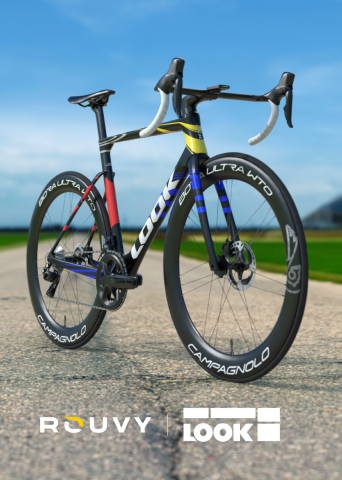
Fred Caron, LOOK Product Manager, reveals how the new 695 was developed, and explains all the innovations of this revolutionary bike.


- What does the integration of elements bring on the 695?

The integration of the various components brings the assurance of ideal compatibility between the elements, as they were developed to work together.
For example, the ZED 2 crankset and its bottom bracket have rigidities that are 100% compatible. Even the bearings are specific and were designed to have the best transmission of effort. This would not have been possible with an existing chain drive.
The integration also allows increasing the quality by freeing oneself of present standards: we develop our own products because we can make more performing products than those found up to now on the market.
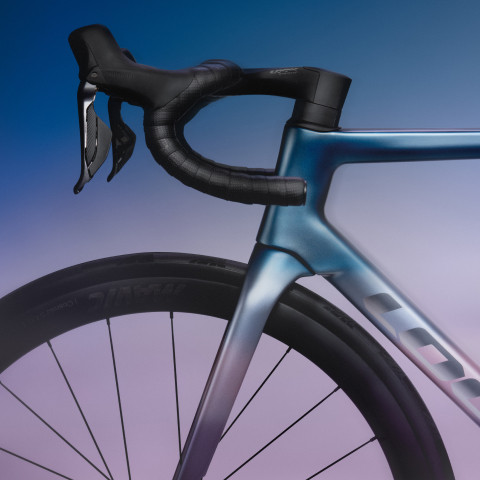
Finally, as for aesthetics, the whole is more accomplished: for example the stem is in the continuity of the tube, the decoration is coherent with the frame.

- What is CFD?

Continuous Fibre Design is a concept that we have developed: we know that carbon fibres have extraordinary characteristics of resistance to traction but not to bending. To optimise the weight/performance ratio, we must thus avoid any sharp angles at the most solicited places. This concept thus allows us to clearly outstrip our competitors with extremely performing parts in Rigidity/Weight. A very striking example of CFD is the HCS7 fork, which shows lines without rupture, notably at the fork crown/pivot junction, a genuine evolution compared with previous versions, since the HSC7 is 16% more lightweight than the HSC6 (295gr) while remaining 15% more rigid.

- How much time did it take to develop the 695?

We should distinguish 2 aspects: the development of the frame itself and the development of the components.
The development of the frame alone necessitated 2 complete years of research and of development. All the integrated components were thought about upstream, 5 or 6 years in advance for some of them. Take for example the Head Fit 3 headset: on the 695, we are now at the 3rd generation; the first came out in 2008, so it took about 4 years of research and of development to arrive at this version. Since 2003, we have had the idea of integrating a crankset (this is why the 486 had a bottom bracket in which we could lodge more important bearings than the standards of that time). The first ZED came on the market in 2009 on the 596. It thus took four years to develop the ZED 2 and to make it arrive in 2011 on a road frame.

- What are the evolutions in relation to the first version of the ZED?

The first ZED crankset already was an evolution in relation to competitors’ cranksets since it was the first single-piece crankset in carbon. On that first version, a specific pedal axis was needed, the shape of which was adapted to the crankset’s pedal crank. Only LOOK pedals were compatible. On the ZED 2, we have kept all the advantages (stiffness, lightweight, possibility of changing the pedal crank’s length), now we have freed ourselves of the pedal axis constraint to become compatible with all types of pedals. The pedal crank’s length change is now done with a three-lobe nut.

- How did the headset (HS) evolve?

The 3rd generation of Head Fit, our patented headset that disassociates the tightening of the stem from the headset settings, is entirely integrated in the head tube. The screw-finish that compresses the headset and that was apparent on the Head Fit 2 is no longer visible. We furthermore have on this version differentiated bearings of 1’1/8 at the top and 1’1/2 at the bottom.

- What is innovating in the C-Stem?

It is the first stem integrated in the frame and it was designed with the fork and not with the handlebar. The great innovation is that it is inclinable but without any articulations. This allows us to eliminate the adding of numerous spacers between the stem and the frame and to be closer to the bearings. We thus obtain a very stiff mechanical link between the steering station and the bike. This improves stability, thus security and performance. The aesthetic has not been neglected: the C-Stem is in the alignment of the upper tube and no screw is apparent, for a very refined visual result.

- We have just seen the latest LOOK innovations on this frame. In all, how many innovations does the 695 gather?

In reality, there are 11 innovations on this bike, adding up to more than thirty patents that were taken out in several countries.
 
- The frame reaches a new lightweight record. How was this made possible?

Thanks to a new carbon composition: we have used new carbon fibres, the fabric of which is lightened: a one square meter carbon sheet only weighs 110 g! Furthermore, the whole development of the frame aimed at the best compromise possible between weight and rigidity.

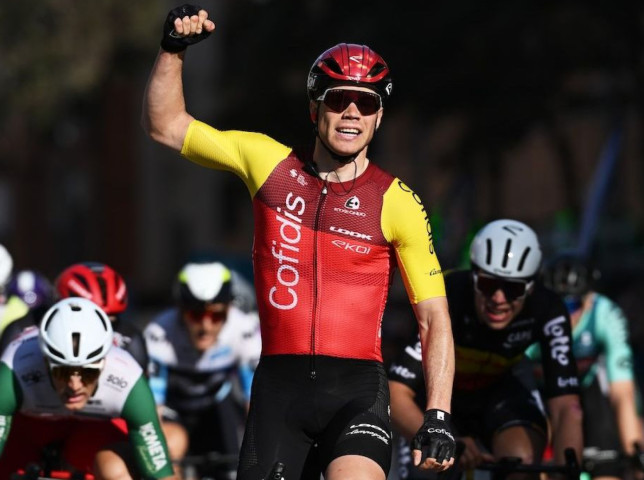
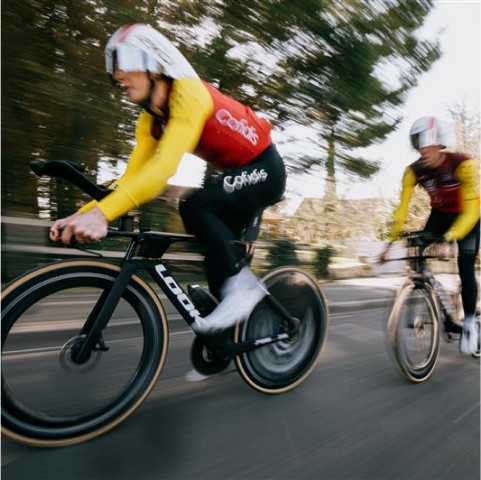
- The 695 equips the professionals of COFIDIS. It is exclusively reserved for competitors?

There are in fact 2 versions of the 695: a Super Rigid version (SR) which is rather for competitors and that is 15% stiffer than the standard version, which is a very high level bike while offering the necessary comfort for long rides. During the development, LOOK made a series of field test with its testers, professionals but also cycling sportspeople and touring cyclists; we analysed the results of the tests and we took the time to fine tune the frame’s behaviour so as to offer two versions to appeal to the greatest number of cyclists. All of LOOK’s know-how and mastery are found here: we can offer two rigidities for a same product only by varying the carbon’s composition. The design and the shape of the frame have an influence on comfort, but that is not all: the carbon’s composition (type of fibre, their orientation and the quantity) is essential factor in the degree of rigidity that we wish to give to the bike.

- How can we sum up what the advantages are for the consumers?

We can say that it is a bike that procures unequalled sensations to this day: highly efficient power and effort transmission owing to the crankset and its ultra rigid bottom bracket, and optimal steering precision. It is a lightweight frame, comfortable, with carefully thought aesthetic.